

Dark Matter implications in physics and religion
(Much of the science below is lifted verbatim from Wikipedia, except where other references are given. Speculations are my own. Figures are referenced.)
Summary: The point of exploring Dark Matter and Spirit in the same discussion is to highlight that there is much of physics that is still a mystery to us, and specifically in exactly the regime for which religion is also mysterious. There is little thinking about how these universal physics concepts might be applied here and now to us. We might consider if the intersection of these two areas of mystery might share some common solution.
- Physics: Dark Matter/Dark Energy: Science has had several historical periods in which scientists thought we “Knew it all”, and there was no more to be discovered, but we are no longer there!
- We know a lot about our local world, and think that we should be able to extend our local knowledge of physics to the whole of the universe. Microscopes, telescopes, accelerators, and similar “scale collapsing” instruments and techniques allow us to explore realms orders of magnitude from the scales we are used to. However, the conditions we find there can be much different that the garden variety physics of our personal experience. Quantum physics and accelerator experiments have shown us a menagerie of closely related entities that make up known matter in a sophisticated set of building blocks and combination rules, which is termed the “Standard Model” of particle physics. (See figure on page 4) However, fundamental particle physicists know that this model is incomplete. Conspicuously absent are the putative particles that make up dark matter, those that convey the force of gravity, or any explanation for the mass of neutrinos.
- Astrophysical explorations and theory have discovered discrepancies from Newtonian physics that suggests that there is a lot more “stuff” in the universe than Newtonian physics, and our senses, suggest! We agree to call it “Dark” matter or “Dark” energy because we cannot see it. It is also called “non-baryonic” matter because its invisibility implies that it does not interact with electromagnetic forces: the essence of “light” and the facility of seeing.
- Key tools of astrophysics presume that some aspects of our local world are also present throughout the universe:
- Force and acceleration between massive bodies
- Atomic physics and its associated spectroscopy: an atom on a distant star should have the same emission or absorption spectrum, under same temperature and pressure conditions, as one locally.
- Acceleration and velocity- Doppler effects (red shift/blue shift) should work the same way across interstellar distances and velocities.
- Special and general relativity (energy/mass correspondence, speed of light limitations, gravity distorting the fabric of space)
- An expectation of homogeneity of the universe, e.g. that general background conditions will be found uniformly across the universe
- The amount of “stuff” in the universe is static, e.g. matter is not being created or destroyed.
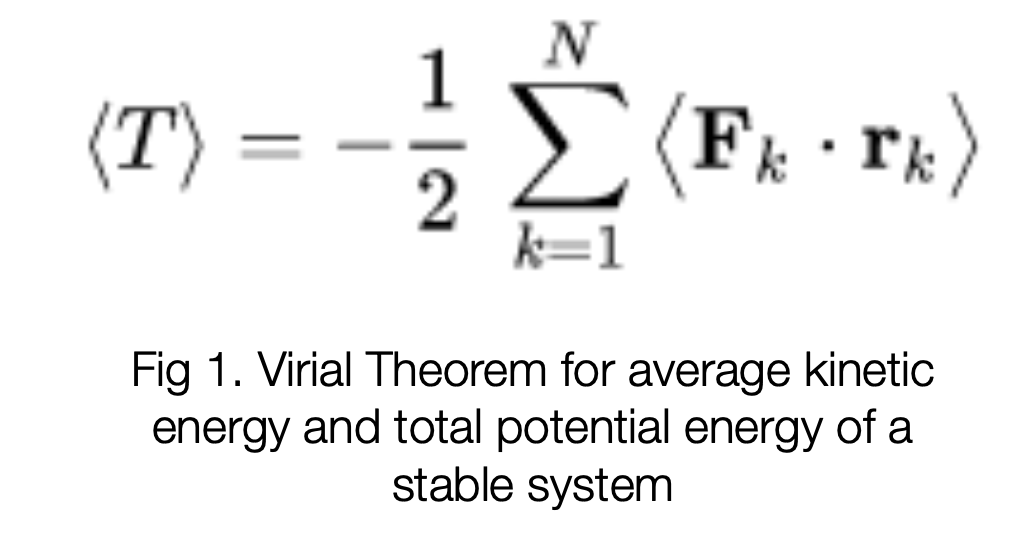
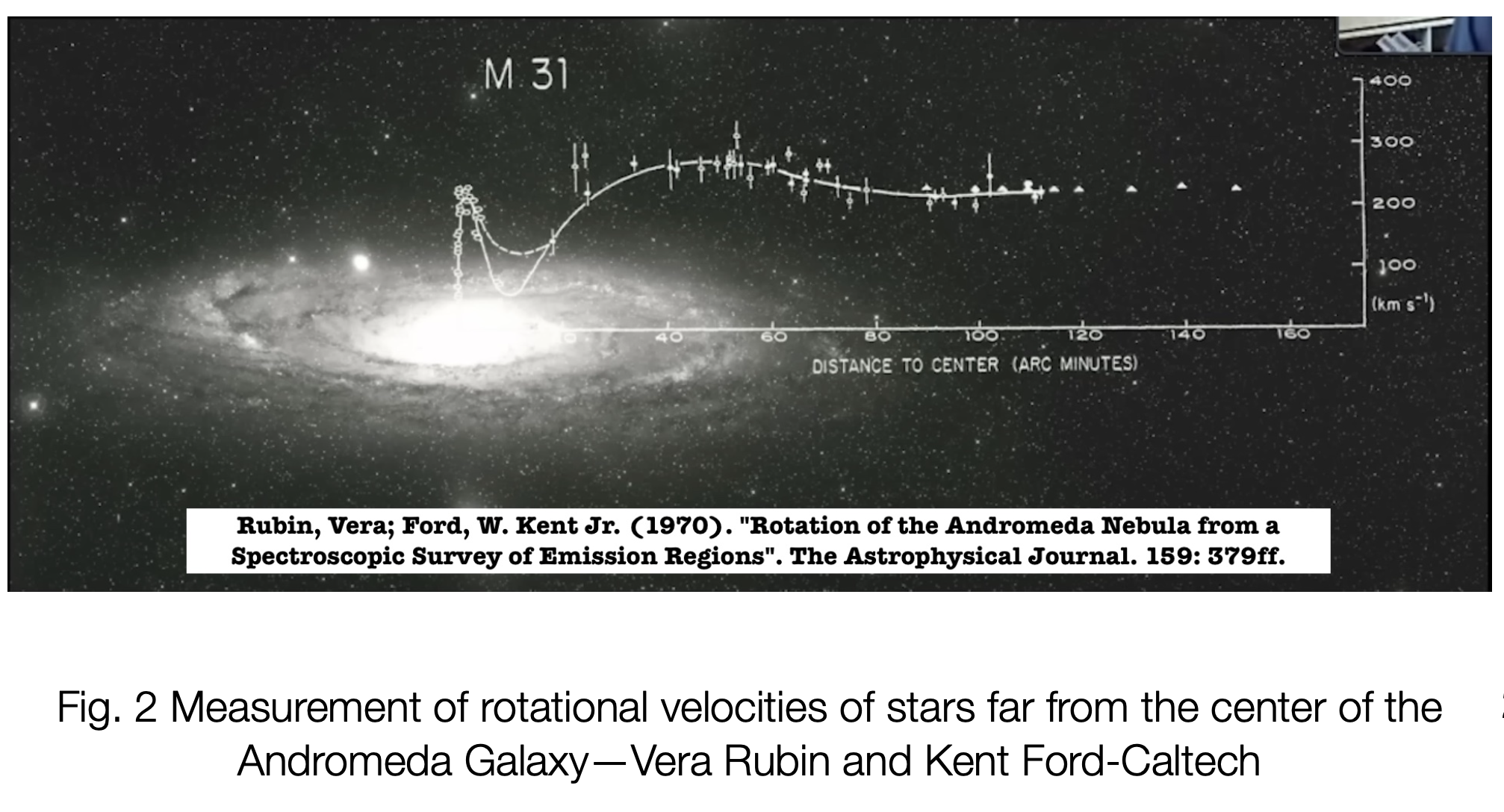
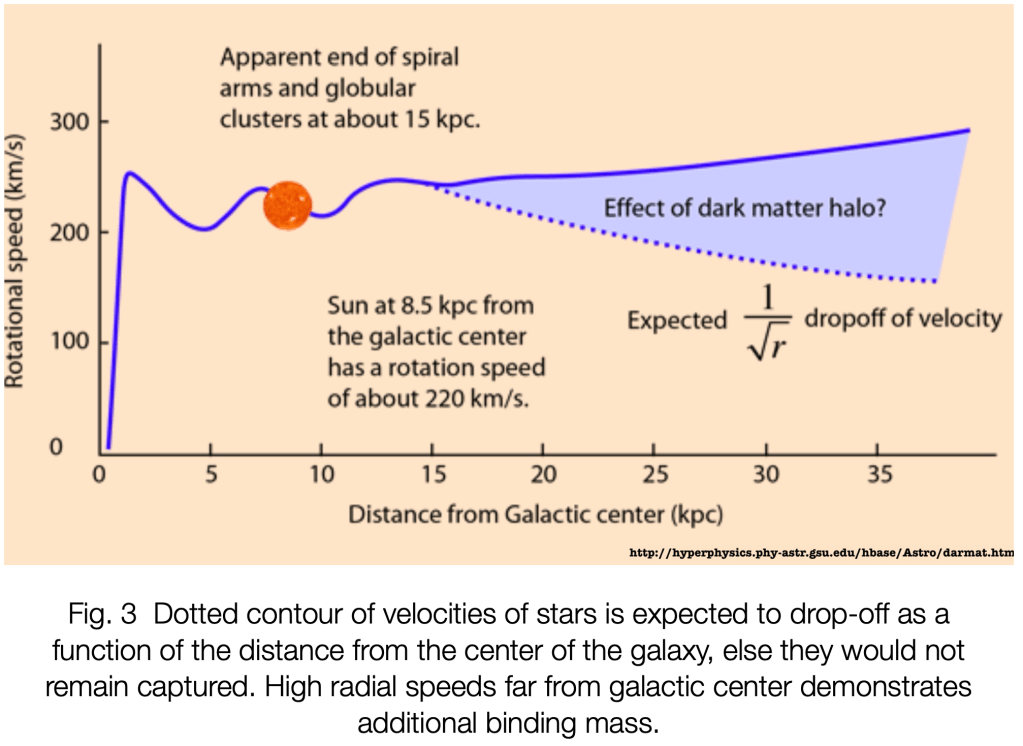
- Fritz Zwicky (Caltech), in a 1933 analysis of distant galaxies, using optical and radio telescopes, spectroscopy, and the implications of the virial theorem, showed that the arms of distant galaxies are spinning at higher rates than should be possible, given the apparent lack of visible gravitational matter holding them intact. The virial theorem ( Fig 1)is a general equation that relates the average over time of the total kinetic energy of a stable system of discrete particles, bound by potential forces, with that of the total potential energy of the system.
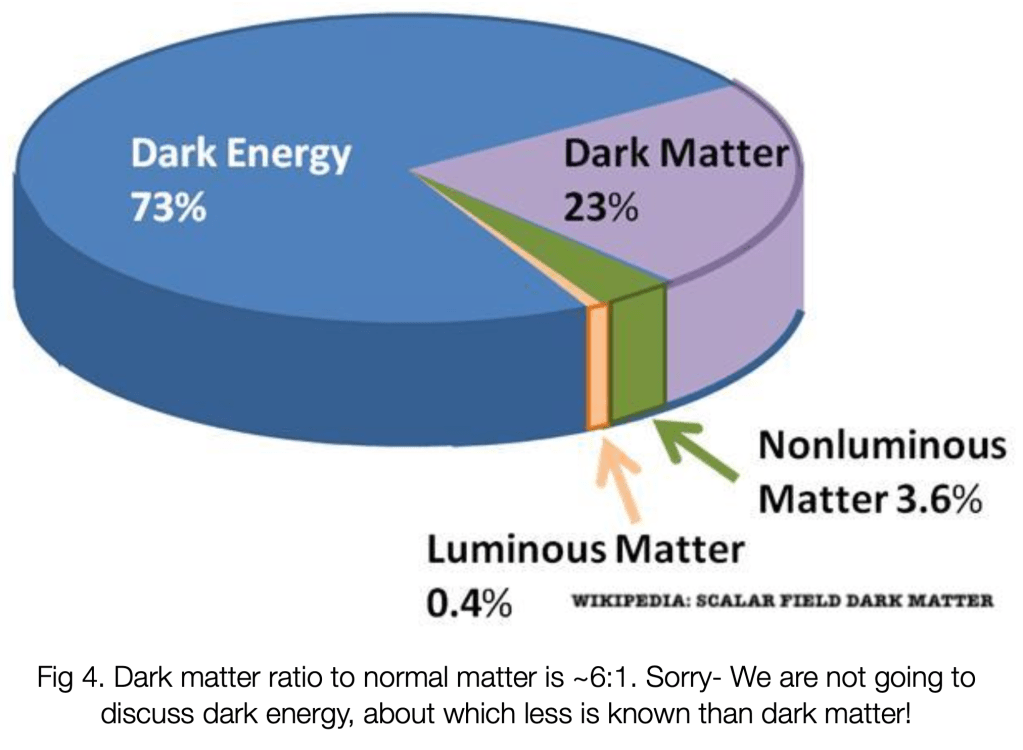
This led to the hypothesis of the existence of invisible, gravitationally attractive, material which came to be called “Dark Matter”, because it was non interacting with electromagnetic forces. E.g. it does not emit light, nor does it block light passing through it. It is estimated that Dark Matter is present in the universe at six times the abundance of regular Baryonic (electromagnetic and gravitational) matter.
- Key tools of astrophysics presume that some aspects of our local world are also present throughout the universe:
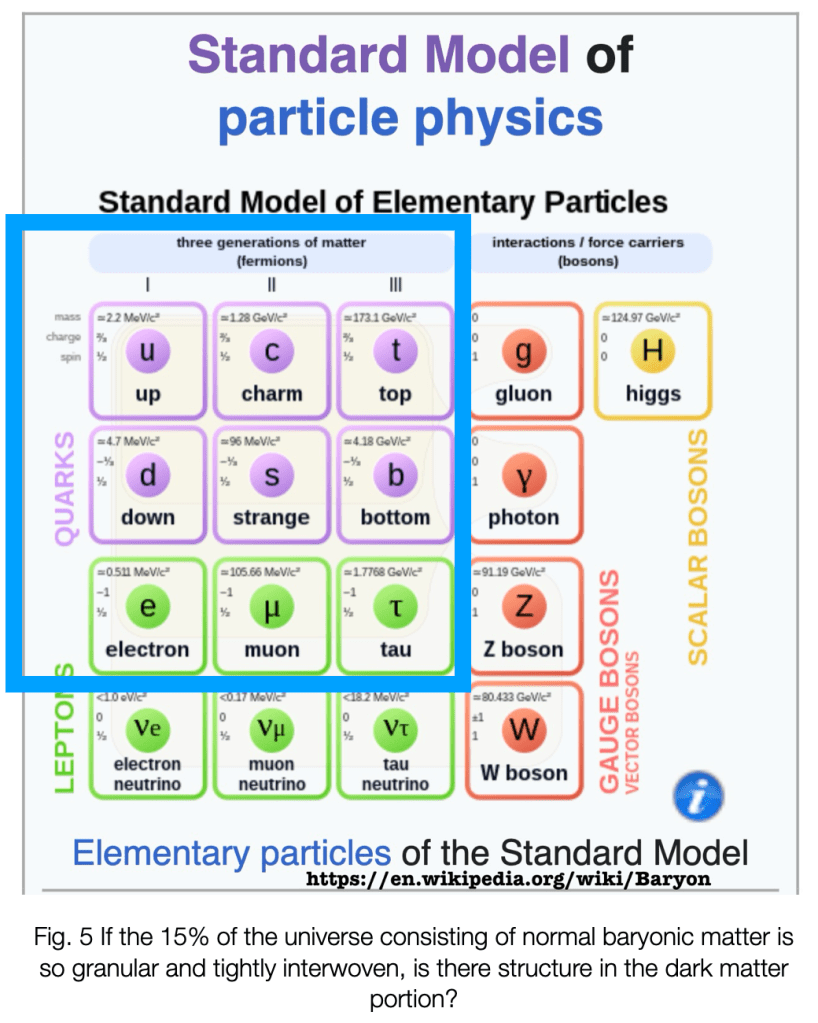
- Particle Physics Models:
- Baryons are strongly interacting fermions; that is, they are acted on by the strong nuclear force and are described by Fermi–Dirac statistics, which apply to all particles obeying the Pauli exclusion principle. This is in contrast to the bosons, which do not obey the exclusion principle. Baryons, along with mesons, are hadrons, particles composed of quarks.
- Non-baryonic matter, as implied by the name, is any sort of matter that is not composed primarily of baryons. This might include neutrinos and free electrons, dark matter, supersymmetric particles, axions, and other matter unknown to us.
- Possible local implications of Dark Matter (my own musings!):
- Is it here, locally? If dark matter is present in the distant universe, should it not also be present in similar amounts locally?
- Distribution? We see that matter in the universe is not uniformly distributed, but clustered in various formations: galaxies, solar systems, nebula, etc. So the amount of Dark Matter local to our solar system may be much less or much more than average. It seems reasonable to me that it could be in similar gravitationally distributed configurations as baryonic matter: dust, and clumps of gravitationally gathered material, like stars and planets. However, in baryonic stars nuclear fusion reactions heat them up so they shine, emitting electromagnetic light as heat. So star-sized clumps of dark matter might not exhibit luminance, or have any reactions. However, since dark matter does exhibit gravitational attractions, it might also have specific high-density , just not observable by us. Still, if the distribution mechanism is gravitational attraction, there is every reason to expect that they will slide down the same gravitational wells as baryonic matter, and contribute concentrically to the masses of baryonic planets and stars.
- Density? The density of our own gravitationally-compacted baryonic matter (stars and planets) is entirely dependent on electromagnetic repulsion to prevent collapse to the range of nuclear repulsive forces- like neutron stars. Does dark matter have any repulsive character? If it does, then we would expect that it is attracted into spherically symmetric bodies, with a outer size determined by the repulsive forces, forming gravitational wells. It would then be gravitationally pulled into spheres whose density is sustained by its own repulsive forces, as is baryonic matter.
- Dark matter black holes? Black holes are cases where electromagnetic and nuclear repulsive forces of baryonic matter are overwhelmed. If dark matter does not have repulsive forces, we expect it to be collapsing into black holes without any restraint. If it has repulsive forces, then these would determine how much dark mass is required to overcome those forces and collapse into a Black Hole.
- Overlapping worlds?! Baryonic matter (us) and dark matter both feel gravitational attraction. Matter of either type would likely coalesce into common centers of attraction during a solar system-forming nebular coalescence, into the Sun, and into planetary centers, which orbit the sun, and maybe into other orbiting bodies. If so, its presence has to have been already accounted in all of our planetary gravitational models, from Kepler on, essentially scaling what we know as mass.
- Different sizes? If the 6:1 ratio estimate of dark matter to baryonic matter holds locally, and if the compacted gravitational density of dark matter to baryonic matter is equivalent (not guaranteed!) then we might expect the Sun to have an invisible dark component of radius 6(1/3)= 1.71 times the apparent radius. Similarly the Earth might have an invisible component with a surface radius of ~6700 miles, compared to the average radius of the surface of the Earth of 3963 miles.
- Could we detect dark matter if it were present locally?
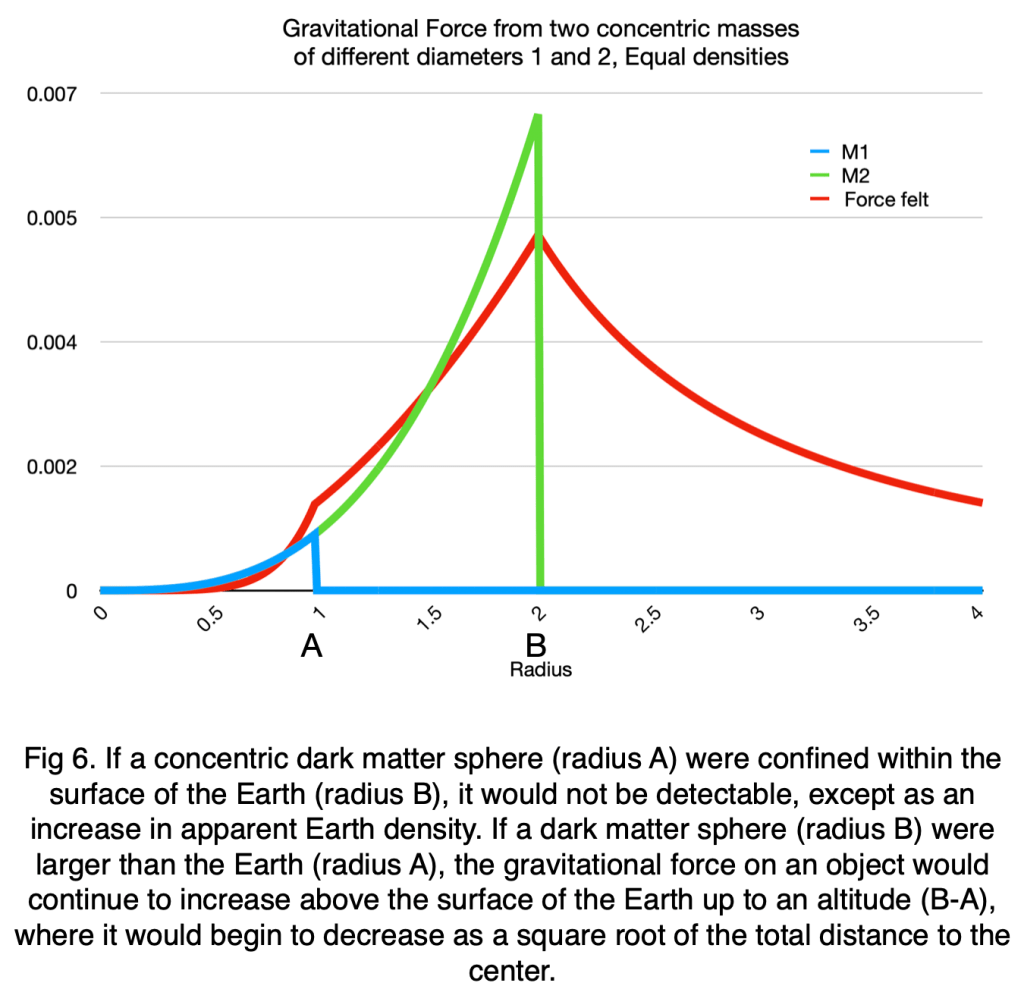
- If our planet includes a dark matter component larger than the diameter of the baryonic Earth, the place to look for local differences in gravitational mass between baryonic matter and dark matter would be an increase in gravitational pull above the Baryonic surface and a deviation from a normal launch trajectory. (See Figure 6.) That is clearly not observed on Earth.
- If the dark matter diameter is less than the diameter of the baryonic Earth, we would see no such deviation, but the dark matter would just increase the apparent density of the Earth. For example, to account for the increase in attractive force due to invisible, concentric, dark matter within the Earth, we might think that the Earth has much higher amounts of heavy metals in the core than actually reside there. So that might be the case and we would not know. The same applies to our estimated densities of other planets and the Sun.
- If there were gravitationally condensed bodies of only dark matter comparable to astroids and comets in our solar system, and their orbits impacted the Earth, we would only see the gravitational variation of their passage. We would have expected planet-sized dark matter bodies in the solar system to have long since combined into planetary gravitational wells, forming composite planets.
II. Spirit and life- a mystery of this world confined exclusively to religion. Is there a point in the future where the methods of science will provide insight and power here as well?
- All human cultures have believed in an invisible world: heaven far above the earth, spirits, gods, ghosts, a pre-mortal life, a post-mortal life, resurrection, etc., based on tradition, visions, dreams, revelation, near-death experiences, etc.
- Science has made a tremendous effort to validate this spiritual belief, and has failed, to the point that any current scientific efforts in examining spiritual concepts and effects are usually met with extreme skepticism and mockery from the society of serious science.
- Alfred Russel Wallace (Darwin’s colleague) and many others futilely conducted rigorous scientific experiments, with inadequate methodology and instrumentation.
- Many “fringe” elements today continue to claim to do research on spiritual science.
- Science, for all it knows of biology, has no biological answer to the mechanism of life. Computer science/cybernetics/artificial intelligence explore some aspects of thinking, but do not have any answer to “life”.
- When we fly into outer space, we do not see any heaven, or heavenly beings.
- Religion explicitly speaks of duality of spirit and body, and heaven far above us.
- The element of life is tied in religion to the “spirit”.
- Religion asserts that spirit is a form of matter that is “more refined” and that cannot be seen.
- Scripture assert that all life (plant, animal, human) is based on the connection of spirit with a body, and created and sustained by God in a process that is not detailed.
- Scripture asserts that God loves and cares for all living things, and that humans are in a special category of “children of God”, with a glorious potential.
- Religion asserts that there will be a transformation of this Earth from “corruption to incorruption”, a resurrection of all humans, and the reign of God on a glorified Earth, forever.
Compelling questions:
- Matter:
- Are there experimental ways to evaluate the contribution of mass of the Earth or Sun, with dark matter, compared to without dark matter?!
- What would be the implications of our baryonic planet being concentric with a planetary body of dark matter?
- What complications might exist for Dark Matter composite particles? Remember, it is hypothesized to make up 85% of the mass of the universe. Why would we think that it lacks similar kinds of complexity and structure seen in the baryonic 15% of the universe mass we know and love?
- Might Dark Matter have its own short range and long-range forces, analogous to electromagnetism and the nuclear strong and weak forces, but different?
- Might it have its own forms of structures, analogous to chemistry and nuclear physics?
- Might it also be composed of a menagerie of different dark matter particles, as we observe with Baryonic matter (protons, neutrons, etc.)
- If there is a companion set of dark matter physics in the universe, might there also be other additional families of matter here, that not only do not share E&M forces but also do not share gravitational forces: Baryonic, Dark, other(a), other(b), …other(n)?
- Spirit
- Should science make another attempt at understanding spirit in the quest to understand life?
- Where in our biological beings might there be a connection with spirit matter? How might we evaluate that?
- Can we, with what we know now, with existing religion and science, seriously construct a spirit/matter model that is meaningful?
 Faith Illuminating Science--Science Illuminating Faith
Leave a comment