Given that the Los Alamos Faith and Science Forum (LAFSF) has taken up a review of aspects of religion and the universe in: Astrobiology and Christian Doctrine: Exploring the implications of life in the universe, by Andrew Davison, and that the thought-provoking science fiction trilogy by Chinese scientist Liu CiXin: The Three Body Problem, The Dark Forest, and Death’s End, have raised much interest, including new dramatizations as two separate, heavily financed, series on Netflix, I thought you might be interested in this discussion.
The Universe and humanity:
The blue veil of the sky and the pull of gravity have protected humanity from a realization of the unspeakably vast, dark, and fearsome depth of interstellar space, populated by innumerable and unbelievably violent nuclear furnaces, gaping expanses of sterile emptiness, and many incomprehensible mysteries.
As the James Web Space Telescope (JWST), the Hubble Space Telescope, and numerous other optical and radio telescopes have recently informed us, the expanse of the Universe is enormous beyond our most enthusiastic imaginations, and filled with an incredible complexity.
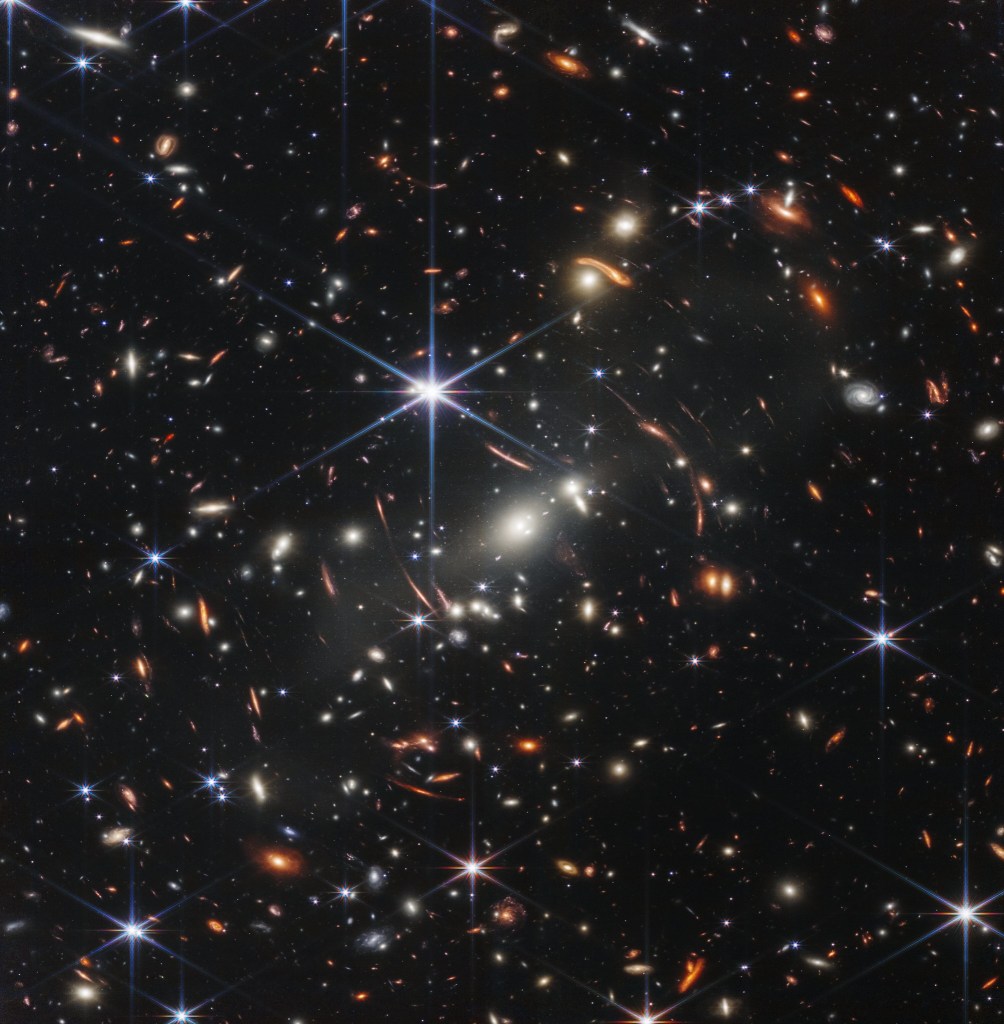
Humanity has pondered the mystery of the heavens from our earliest times. Abrahamic religions (and others) claim to have their foundation in the Creation: of the Earth, of the Heavens, perhaps of the entire Universe!
Religious concepts of what the heavens entail have been vague and without detail: high above us, beautiful, celestial, “where God lives,” etc. With observational science and technology, advanced scientific knowledge of the heavens and the Universe have left religious concepts far behind. Science does not see anything matching descriptions of the heavens from legacy Abrahamic religion, or any other religious view. Early astronauts noted the absence of angels or of God on their upward rocket flights. Most of religion has no explanation for this disparity between religious promises and science observation.
Great thinkers have explored the implications of the vastness of the cosmos and its innumerable host of galaxies, stars, planets, clouds of gas and dust. As scientists, we have developed models of stellar formation, evolution, and demise, and have found examples confirming many of those models in the vast menagerie of astronomical observation. As always with science, the more we advance knowledge, the more details we uncover. These often lead to new mysteries, and refine or break old theories. We see new horizons: e.g.: unseeable matter with gravitational pull, incomprehensible “dark energy” pushing the universe apart, a menagerie of fundamental forms of matter that increasingly are shown to be incomplete in composition, nature, and relationships.
Life in the Universe:
There was then, and continues to be, including among our Forum, a popular assumption that the generation of life is a random process, requiring only the “right’ combination of materials and conditions in a primeval “soup” sparked by a lightning bolt. This is known as “abiogenesis.” (*for a discussion of the actual degree of impossibilities of spontaneous generation of life, see ldsfaithandscience.org/origins-of-life/). In the discussions below, there is a difference in the logic between abiogenesis, and God-created life. I will not explore all of these, but be aware there is a difference.)
Implicit in these considerations of life among the stars are several observations from what we have seen of terrestrial life:
- The Big Number problem: If life is generated spontaneously under “right”circumstances across the universe, then what is special about our world that life here should be unique? So with vast numbers of worlds, abiogenesis advocates should expect many other living planets.
- The time scale over which life has progressed from primal cells (already very complex) to advanced life forms on Earth has been 3.7 billion years.
- Once intelligent life began spontaneously organizing civilizations with cooperative societies, the time to develop serious technology is a few 10’s of thousands of years. The time from the Enlightenment to space travel and long range communication is only a few hundred years. (I do not believe it is spontaneous, that these successful societies do NOT happen without the focusing commandments of God that have enabled faithful and persistent families and respectful societal relationships)
- If civilizations (intelligent life) are spontaneously generated in nature across the universe, then because the universe is so vast, and so densely populated by stars, there must be many, many of them. The formation of stars naturally produces orbiting planets. Once a civilization is established, population growth is exponential (explosive!), and progresses until raw materials are consumed. This quickly motivates interstellar expansion.
- Once a civilization gains technological power to travel from its birth world, even with only nuclear propulsion (no reason to posit faster than light transport, worm holes, etc.), it is limited only by the vast distances of interstellar space from populating and consuming other star systems. Even with this time delay, colonization growth would be exponential, given sufficient resources. Such multi-stellar civilizations could become vast, spreading to many star systems over sufficient time. Expect technological sophistication and power to continue to grow with time.
The Fermi Paradox: In 1950, the great physicist, Enrico Fermi was contemplating the vastness of the universe, and the question of interstellar life.
So given these logical insights, Fermi asked, “But where is everybody?” Why is there not lots of “radio chatter”? That question is known as the Fermi Paradox. Carried by the revelations of the JWST of exponentially greater numbers of star systems than previously thought, the question escalates, why the silence? Why not chattering radio waves? Why no visitors? (Are God and angels interstellar visitors?)
Conflict of civilizations on Earth:
The history of humanity witnesses a long, varied, and tragic set of experiences where contacts between civilizations apparently always have resulted in actions of violence, wickedness, cruelty, greed, and efforts of subjugation or annihilation by mankind.
These incidents include: the Chinese in Korea, Japanese in the Pacific Archipelagos, Scandinavians across Europe, Mongols across Eurasia, Europeans in the Americas and Africa, …, etc. It is really a much longer list, touching every people, including many that have been annihilated.

Siege of Arcot 31st August to 15th November 1751 in the War in India: picture by Cecil Doughty
(I have to mention here the cliff ruins near where I live and in many other locations across the American Southwest. Ancient peoples built stone forts high up on cliff faces, under overhangs, far from water or farmlands, These were clearly extreme and desperate measures for defense against other dangerous humans. For example, the Mesa Verde cliff communities housed an estimated 22,000 people, in a desolate and inaccessible area, but only 20 miles from the verdant Mancos River valley. Archeologists understanding of what were once seen as peace-loving native peoples have been modified by evidences of cannibalism in their trash pits. These were not peaceful or safe peoples.
There was no established land ownership in perpetuity. All of these lands were contested. Wave after wave of invading peoples have displaced each other through violence, throughout human history. 
Emily Pennington: Originally Published Sep 27, 2020 Updated Sep 12, 2022
This situation is best illustrated by the YouTube video here: https://www.youtube.com/watch?v=uOWP4EgPYvg)
If this is the fearful, greedy, violent human experience, what should we expect from other worlds around other stars?
(I will note in passing that our current, relatively peaceful, world is enabled by the teachings of God, from Adam to Jesus Christ, which have diffused and been implemented in many aspects of the current world, by many paths, some not visible. Recently, this has been through the settling of the US by Christian peoples, and the incorporation of values of “life, liberty, and the pursuit of happiness”. So one might not expect Western liberal restraint from stellar civilizations, without God’s intervention. )
Interstellar relationships: the Dark Forest model:
A number of science fiction writers have explored the interactive nature of a universe which has a potential distribution of intelligent and powerful civilizations, each possessing attitudes toward others whichrange from benevolent to vicious. One construct has been refined by the Chinese writer of the “Three Body Problem” science fiction series, Liu CiXin, a computer scientist.
The problem of “the Dark Forest” as Liu CiXin frames it, is thus: The universe is a Dark Forest, populated by fearful, malevolent, and powerful civilizations who are dangerous. You must remain quiet and hidden or any of the other civilizations who encounter you will try to destroy you. Survival of our civilization requires not only strength, but silence. This is recognized by all surviving interstellar civilizations, hence the radio silence across the universe.
Several subordinate points support this thesis:
- Any interaction between different civilizations is likely to be competitive and combative, if they are competing for the same set of resources. Human experience on Earth leads us to expect initially hostile, even devastating, interactions.
- The probability of having large disparity levels of technological power between civilizations is high- one of them will always have the upper hand technologically. (Consider the Spanish Conquistadors arriving in the Inca capital in 1532: Pizarro arrived on foreign ground with 168 men and with horses, firearms, and steel weapons. They slaughtered 6,000 of the Incas in short order, on their own ground, then another 50,000, and defeated that civilization. Similar Spanish victories happened a number of times.)

Francisco Pizarro Occupies Cuzco, by Theodor De Bry, 1533, via Mary Evans Picture Library - Thus, any such civilization within a Dark Forest Universe will be motivated to NOT reveal itself to any others, lest they respond to the implicit threat with devastating violence.
- Human history knows a lot about the dangers of state interactions. From Cardinal Richelieu, to Carl Von Clausewitz, to Henry Kissinger, to Mao Zedong, to George Kennan, many have sought a safe path among nations.
Well, Liu CiXin’s speculations and drama are interesting and entertaining, but lets take the universe as he frames it and examine how religion might be involved.
Religion and the Universe:
Religion, in any sense, postulates answers to existential questions: Who are we? What is the universe? Who is responsible? How should we relate to higher powers?
These are very broad-stroke questions, and philosophers and theologians can only handle broad sweeping propositions. There is very little granular detail in legacy religion, because data (revelation, relayed experience) is sparse, may be obscured or changed in transmission over long times and many relays. Dogma establishes some doctrine within residual religious organizations, but with no mechanism for change, or refinement, except via revelation from God. Unfortunately, new revelation from God is foreclosed by the power structures of legacy Christianity, Judaism, and Islam, much as the Jews were resistant to revelation from Jesus and His Apostles.
Science, on the other hand, loves specificity and seeks new data, especially data confounding established theories, and it is precisely in that confounding data that the ever-expanding detail of our knowledge and understanding of the universe is obtained.
So, legacy religion has been pretty stuck, unable to respond as the explosion of knowledge of science about the broader universe has come to us. However, the modern, revealed religion of the Church of Jesus Christ of Latter-day Saints (LDS), in which ~1300 pages of new scripture have been added to the legacy Bible, and many more books and revelations are promised by God, does touch on the questions of the universe, albeit sparsely.
The revelations God gave to Joseph Smith Jr. in LDS scripture speak broadly of God as the Creator, but it is unclear what that means within the broader context of the universe which science describes.
31 And behold, the glory of the Lord was upon Moses, so that Moses stood in the presence of God, and talked with him face to face. And the Lord God said unto Moses: For mine own purpose have I made these things. Here is wisdom and it remaineth in me.
32 And by the word of my power, have I created them, which is mine Only Begotten Son, who is full of grace and truth.
33 And worlds without number have I created; and I also created them for mine own purpose; and by the Son I created them, which is mine Only Begotten. …
35 But only an account of this earth, and the inhabitants thereof, give I unto you. For behold, there are many worlds that have passed away by the word of my power. And there are many that now stand, and innumerable are they unto man; but all things are numbered unto me, for they are mine and I know them.
Religion’s Focus:
(Before I go further, what I say below is not necessarily doctrine of the Church of Jesus Christ of Latter-day Saints. It is speculative, based on some LDS doctrine, combined with scientific insights, and I may modify my views as I learn more.)
Abrahamic religion, and it’s extension in LDS scripture, are all focused on two prime objectives: human’s loving relationship with God, and human’s loving relationship with each other (you remember Jesus’s statement of the two great commandments?). God requires humans to not just be good to each other, but to be fully invested and actively benevolent to each other, with genuine love. This is a high standard which few of us attain.

In spite of humanity’s below-mediocre performance in these regards, yet in the course of obeying God’s social commandments, we have none-the-less been led to forming prosperous, peaceful societies in which governments are established, marriages and families function and prosper, and where societally-corrosive practices of murder, theft, dishonesty, sexual promiscuity and infidelity, are reduced. In both ancient Abrahamic scripture and recent revealed LDS scripture, the case is repeatedly made that human societies which comply with God’s laws prosper, propagate, and are peaceful. When righteous societies fall away from obedience to God’s laws, they quickly degenerate and become violent, lawless, and self-destruct. Large scale wars result. These underscore the conventional historical accounts of great organized societies: in the Bible, Egypt, Greece, Rome, Macedonia, Mesopotamia-America, South America, etc., which decayed into corrupt and ineffective societies. (You may ask where America is along that cyclic path.)

Is it God’s work to counter the Cosmic Dark Forest?
These concepts we discuss here of: an inherently dangerous and predatory universe, and a God whose prime focus it is to establish order and harmony across the universe, are complementary.
One of the great unanswered philosophical questions of Hellenistic Christianity is: “How can there be evil in a universe created in its entirety by God?” If, for the purpose of discussion, we relax the requirement that God has to be responsible for everything, and that there exists in the Universe other wills that are independent of God, then the battle between good and evil becomes meaningful, with real risk, and an outcome that requires planning, training, and effort.
- It maybe sufficient to say that God is a civilizer and a colonizer in this dangerous Universe, and that He is progressively imposing order and peace using His principles of civilization. We do not need to know much about the forces of opposition. We do not need to know of His grand strategy, or His span of control. We only have information on His activities as they apply to Earth, and His revelations to us, but we might extrapolate from our experience to broader insights and questions.
Good and Evil: There is an eternal battle going on between “good” and “evil”, but I believe the discussion is wrongly framed. Philosophers have debated Manichaeism, and have settled the debate by fiat, declaring that God is all powerful. But they do not settle “the problem of evil.” Lets not debate that here, since the whole discussion of the Dark Forest hinges on real combat.
- Rather lets discuss Good and Evil as they are manifest in the dangers to adjacent stellar societies: Within our mortal, and pre-mortal probationary, training experiences, “Good” and “Evil” have been fully defined by God’s commandments to us here. “Good” is obedience, “Evil” is disobedience.
- I believe that those good/evil terms apply to actions and intents, that have the functions of:
– Good: love and respect for others, enabling agency, advancing voluntary harmony, order, and cooperation as organized by God. Instruction, love, debate, and persuasion, are all positive social process for resolving differences. Good results in prosperity, agency, safety, and harmony.
– Evil, which includes: hate, coercion, selfishness, rebellion, and this leads to: destruction, oppression, loss of agency, and willful cruelty. Evil results in compulsion, unhappiness, destruction, strife, limitations of effective societal size.
God is confident that His version of righteousness will prevail, in every battleground.
- I believe that those good/evil terms apply to actions and intents, that have the functions of:
- We might ask, ‘Is God’s focus on harmony, obedience, and order the result of` experience sometime in the past with destructive chaos?”
The nature of Life and Intelligence: God created life on Earth, and on innumerable other worlds (see the Moses scripture above).
- Life on Earth is remarkably diverse and adaptive, filling most environmental niches, which are extremely varied. However, we see environments beyond Earth that are wildly different from here. Can there be life in other places in the universe much different from what we see on Earth?
- Do we know that only “God-created” life exists in the universe? Might there be other life forms? Are there “frontiers” beyond which God’s work has not yet reached?
- Do we know that the amino-acid, left-chirality, DNA-based life of Earth is biologically compatible with any other life God created on other worlds? (Note that our world is completely based on repurposing proteins from other terrestrial life forms, “tastes like chicken!”) It is improbable that limited set of terrestrial-life protein structures can be “eaten” e.g. repurposed, by biological systems not specifically designed for such reprocessing. They would likely use different proteans and enzymes, if they were even carbon based! There might be many different non-terrestrial biological systems!)
- Are all other life forms and their societies comparable with ours in terms of physical size, operating time scales, temperature, physical condensed states of matter, water-based chemistry? We care about parameter scales of: meters, minutes, 98.6 F degrees, water, and solid/liquid materials. Are these “Goldilocks conditions” universal? What else could there be in that vast marvelous universe? (How about 100-km sized beings within nuclear plasma fireballs, with relevant time scales of millennia?) If other intelligent beings are vastly different, they might not be impacted by us, or we by them. JRR Tolkien’s discussion of tree-like Ent beings whose time-scale of relevance is so long as to hardly notice mammals activities, comes to mind.
- In this context, it is remarkable and informative to note that from its first, earliest, and most primitive instantiation, cell-based life on Earth does not display to us any evidence of the insertion of independent branches of biochemistry that do not come from that one primal origin. This implies to me that there have not been any transfer of living things from other worlds with different bio-chemistry. That in itself may be evidence of the difficulty and improbability of interstellar travel.
Creation of our local Earth: In Genesis, God said that He created the Earth and “its Heavens” in a single project. Modern science tells us that our solar system is small and local in a very large universe. This “creation project” within our relatively small solar system, is an activity lasting about 14.6 billion-years to date. It makes more sense to me that God was speaking to Moses of a “local” project in Genesis, as opposed to God having created the vast Universe altogether when He was working on our planet (even though many legacy Christians believe the latter). God told Abraham that He gathered material present in space and brought it together to form “an Earth upon which these may dwell”.
- While the mechanism for material collection is not given, that star system/planetary evolution progression view given in Genesis and Abraham certainly make sense, given what we know of the range of development of gravitationally-driven star systems and galaxies, etc., across the observable universe.
- How many such planetary projects does God have in progress at this time? Do His work span the whole universe?
- What are His larger organizational objectives and projects?
Inter-stellar relations: the Dark Forest/God’s alternative
- If our Universe, outside of the influence and order provided by God, is a fearful and dangerous “Dark Forest” as described by Liu CiXin, then the following make sense:
- For God to impose strict rules of order, in which He may forbid interstellar communication, except through His revelatory channels.
- For God to firmly oppose any chaotic civilization, but set up a process in which He teaches individuals within emerging planetary civilizations, principles and practice of: laws of order, productivity, and prosperity, and in which He specifically disables the rebellious and wicked, who would otherwise spread disorder, destruction, and chaos. Such a society would be harmonious. Key principles include obedience, humility, selflessness, service, meekness, repentance. These are prime principles Jesus taught.
- He would counter any forces that threatens His Heaven. Thus when Lucifer rebelled and wanted to impose compulsion on mankind to require compliance to societal commandments, rather than to rely on willful obedience and love, God knew that this was unstable, and ineffective, and would result in a Hell, instead of a Heaven on Earth. So He opposed Lucifer, and cast him as Satan down onto this planet, as un-embodied spirits, never to gain bodies. (Ooops- we should talk about pre-mortal existence, spirits, bodies, and a progression to Resurrection and Heaven—but this paper is already too long.)
- A process whereby intelligent beings are refined and elevated by God to a powerful capability, trained in these principles, and filtered by their commitment to them, (heaven), makes sense.
- LDS theology teaches that this period of human existence is a “controlled environment” in which knowledge of God’s larger activities, the “big picture,” are largely obscured during this development, training, and testing process. A premortal existence, acquisition of a physical mortal body, training in principles and values, testing for obedience, selfishness, willfulness, and wickedness, and refinement to holiness, is then a process of development in preparation for populating worlds with powerful and good beings who will maintain order, prosperity, and peace.
- Finally, then, God has created worlds with positive, thriving life, which may establish and maintain a harmonious universe, continually exponentiating capability and power.
- Are there other forces and dominions across the universe in opposition to God’s efforts? As we learn of the vast universe, might there be such a duality, or multiplicity of interests and powers? We know of Satan/Lucifer, his rebellion, his aspirations, but without a larger context.
There are many questions which may remain from this construction. We could talk about God’s plan for this Earth:
What happens after the general Resurrection? What is the Earth’s mission? What is God’s ultimate objective?
Summary: So the concept of the Dark Forest frames potential power environment between interstellar civilizations. Religion is all about getting along together in families and civilizations. God in the Bible and in the Book of Mormon is active in advising His peoples in their relations with their neighbors, both guiding external actions and internal harmony.
While the Bible is silent on God’s interstellar interests, the revelations of the latter-days have provided hints of God’s larger range of interests that are intriguing. This discussion begins an exploration of religion among the stars that joins values of cooperation and harmony experiences among states on Earth, with the dangers imagined in the larger universe.

Greg Newbold painting titled “Nauvoo the Beautiful.”
Copyright Gary Lane Stradling 2024
 Faith Illuminating Science--Science Illuminating Faith